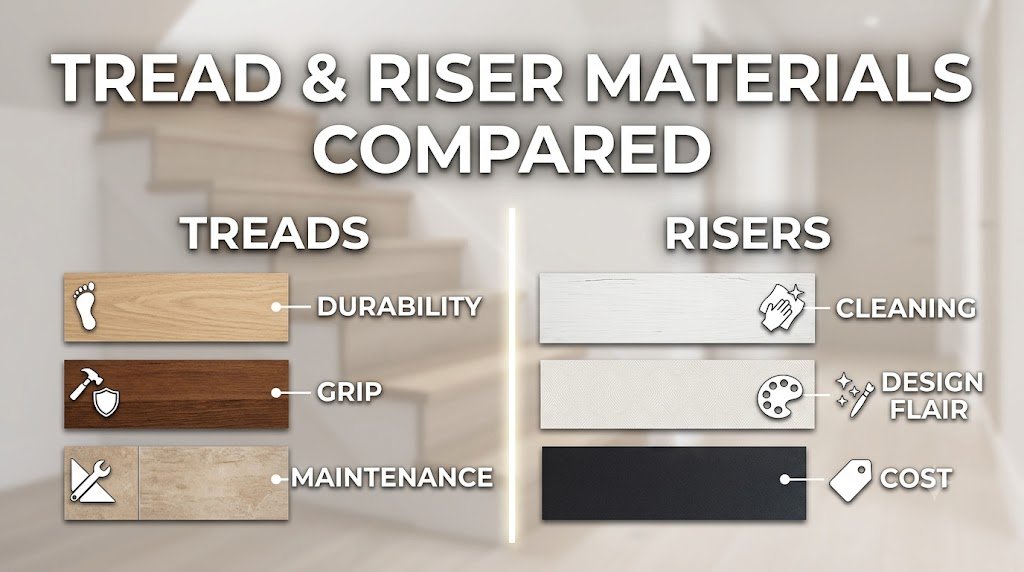
For a typical 13-riser, 14-tread residential staircase, material cost alone ranges from roughly $350 in painted MDF to $2,800+ in solid hardwood — before labor. The right choice depends less on that price gap and more on foot traffic, subfloor type, and whether the stair is open or closed riser.
Comparing Stair Tread and Riser Materials
Every material trades off cost, durability, installation complexity, and sound underfoot differently. The table below uses national-average material cost per step (not per square foot, since a tread/riser pair varies less by stair width than raw flooring pricing does) — run your exact step count and material through the tread and riser material calculator for a project total, since a 12-step and an 18-step staircase can differ by more than a thousand dollars in the same material.
| Material | Cost/Step (Material) | Lifespan | Best Use |
| Solid hardwood (oak, maple) | $45 – $90 | 40+ years, refinishable 4-6x | High-traffic main stairs, resale value |
| Engineered hardwood | $30 – $60 | 20-30 years, refinish 1-2x | Over radiant heat, moisture-adjacent areas |
| Luxury vinyl plank (LVP) | $15 – $35 | 10-20 years, not refinishable | Basements, rental units, budget remodels |
| Porcelain/ceramic tile | $25 – $70 | 50+ years, near-permanent | Outdoor steps, entryways, wet climates |
| Carpet (mid-grade) | $20 – $45 | 8-12 years | Bedrooms-level stairs, sound dampening |
| Painted MDF/pine | $10 – $25 | 5-10 years before repaint | Budget builds, temporary staging, rentals |
| Natural stone (slate, granite) | $60 – $150 | 50+ years | High-end exterior, luxury interior builds |
Labor cost tracks complexity more than material cost — solid hardwood and tile both require skilled installation (roughly $40-$80 per step in labor in most US metro markets), while LVP and carpet run closer to $15-$35 per step because the installation tolerances are more forgiving. Compare your specific material pairing directly with the carpet vs hardwood stair cost calculator or get a full project estimate with the stair installation cost calculator.
Which Material Actually Holds Up on Stairs?
Stairs see concentrated point-load traffic on the nosing edge — the front 2-3 in of every tread — that flat flooring never experiences. This is why a material can perform well on a floor and fail early on a stair: LVP that’s rated for 20 years on a level floor often shows nosing wear within 5-7 years on stairs unless it’s a stair-specific product with a reinforced nosing cap.
Solid hardwood wins on longevity because it can be sanded and refinished multiple times as the nosing wears, resetting the clock without replacing the tread. Engineered hardwood can only be refinished once or twice depending on veneer thickness — check the wear-layer spec before buying, since a 2 mm veneer supports one light refinish while a 4-6 mm veneer supports two to three.
Tile and stone don’t wear the way wood does, but grout lines on a stair nosing edge take direct impact and chip or crack faster than field grout — a rounded bullnose tile piece specifically made for stair edges outperforms a cut standard tile at the nosing by a wide margin.
Common mistakes
Choosing tread material by floor-level appearance alone. A wide-plank hardwood that looks great on a floor can be structurally risky as a stair tread if the plank width exceeds the manufacturer’s stair-rated span, since the tread has to bridge the full run unsupported at the nosing edge. Confirm stair-rated width before ordering the same product used downstairs.
Skipping a stair-specific vinyl product for standard LVP. Standard click-lock LVP isn’t rated for the flex and edge exposure of a stair nosing and will lift or crack at that edge within a few years. Stair-specific vinyl tread-and-riser kits cost more per step but include the reinforced nosing cap that standard product lacks — see the vinyl plank stair calculator for the correct material quantities.
Ignoring subfloor deflection ratings for tile or stone. Tile needs a rigid substrate — typically an uncoupling membrane over a plywood stringer assembly rated for less than L/360 deflection — or grout lines crack within a season. This is a more common failure point than the tile itself.
Underestimating repaint/refinish frequency in the cost comparison. Painted MDF looks cheapest upfront but needs repainting every 2-4 years on high-traffic stairs, which can exceed the lifetime cost of a mid-range engineered product over a 10-year window. Run the stair refinishing cost calculator against your expected traffic level before deciding on budget material.
Related calculators you might need
Once you’ve picked a material, size the actual quantity needed with the tread and riser material calculator. If you’re choosing between two finish options on cost alone, the carpet vs hardwood stair cost calculator breaks down material plus labor side by side. For a full project number including removal and prep, use the stair installation cost calculator. If a painted finish is on the table, the stair paint and stain calculator estimates coverage, and stone or concrete builds should check the concrete stairs calculator for the structural side of the material choice.
Frequently asked questions
What is the most durable stair tread material?
Solid hardwood and natural stone both last 40-50+ years, but hardwood has the practical edge because it can be refinished in place multiple times as the nosing wears, while stone that chips at an edge usually needs the individual piece replaced. For unsealed high-moisture areas, porcelain tile outlasts both.
Is LVP good for stairs?
Only stair-rated LVP with a reinforced nosing cap — standard click-lock plank flooring wears and lifts at the tread edge within a few years under regular foot traffic. Stair-specific kits cost roughly 20-30% more per step but are built for the edge stress a flat floor never sees.
How do I calculate how much material I need for stair treads and risers?
Multiply your total tread count by tread width plus depth, and riser count by riser width and height, adding a 10-15% waste factor for cuts — but do this per-step rather than as a flat square-footage estimate, since winder and landing steps use more material than straight-run steps. The
tread and riser material calculator handles this per-step calculation automatically from your stringer count.
Can you mix carpet and hardwood on the same stair flight?
Yes, but not mid-flight — the transition should happen at a landing, not on a single step, or the riser heights on either side of the switch will read as mismatched even when they’re dimensionally identical, because carpet pile height changes the perceived and functional riser dimension.
What’s the cheapest durable option for stair treads?
Engineered hardwood at $30-$60 per step material cost offers the best durability-per-dollar for most homes — it handles moderate traffic for 20+ years and can be lightly refinished once, unlike carpet or MDF which need full replacement or repainting well before that mark.

Written by
Site Editor, mystaircalculator.com · Implements and verifies the site's calculators, and writes practical guides that connect reviewed formulas to real-world stair installation
Leave a Reply